Risk-Tranching Protocol
Designed the economic model that splits any yield-bearing asset into a protected senior and a first-loss junior tranche, with the risk premium set dynamically by market demand.

The Problem
A single vault forces one risk profile on every depositor. But risk-averse users like institutional capital might want downside protection at a lower yield, while crypto-native capital is looking for higher yield and is willing to go further out the risk curve for it.
Borrow loops have been a popular way of increasing yield (and risk), but these strategies come with downsides. They require asset supply (e.g. USDC) on lending markets to borrow, reducing their capital efficiency. Additionally, leveraged exposure via loops can create systemic risk, especially for tokenized assets where the underlying has limited liquidity, such as private-credit-based RWAs with limited periodic redemption capacity.
Tranching can provide an alternative way of expressing yield and risk preferences in a self-contained system.
Approach
In my opinion, tranche markets should optimize for risk first and use yield as the lever to coordinate the market around it. The chosen design makes coverage, the share of total value locked (TVL) sitting in the junior tranche, the key goal metric.
A curator sets a target coverage at market creation. The protocol then shifts yield between tranches based on the gap between actual and target coverage. Coverage below target raises the junior annual percentage yield (APY) to attract first-loss capital, which mechanically lowers the senior APY because both tranches share one underlying yield. Coverage above target compresses the junior premium until it converges with the senior rate. Neither side reads an external benchmark.
Adaptive Boost Curve
Three parameters determine the junior APY boost curve: target coverage, target boost (the junior APY premium at target coverage), and two slopes controlling steepness below and above target.
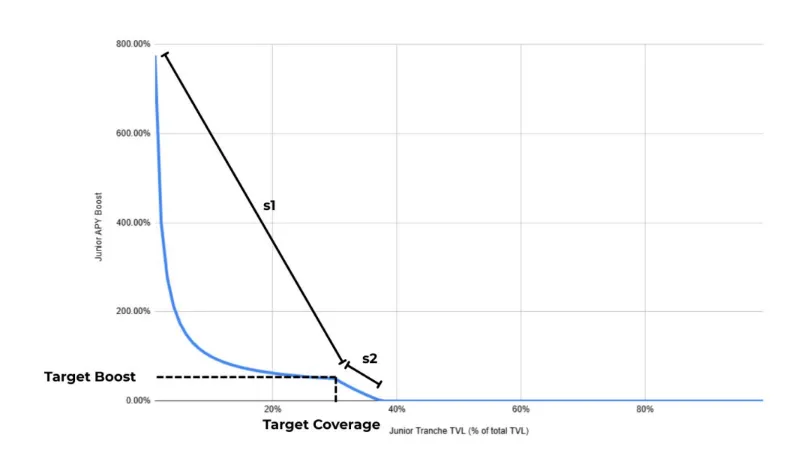
Furthermore, the boost curve itself moves. An adaptive mechanism recalculates the target boost, with the adjustment based both on the size of the gap between realized and target coverage and how long the gap has persisted for. The anchor point shifts up or down, the whole curve moves with it, and the market clears at the risk premium that actually brings coverage to target.
This is inspired by Morpho’s adaptive interest rate model, applied to coverage instead of market utilization.
Optional Junior Leverage Mechanic
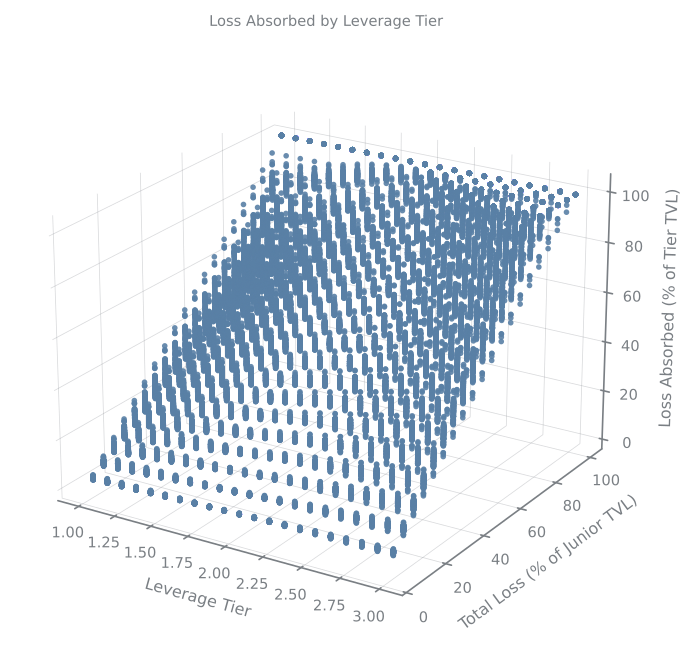
Tranche market curators can optionally enable Junior Leverage, which allows junior tranche depositors to select leverage relative to each other without touching the senior tranche’s protection.
- Floor yield: Every junior depositor receives at minimum the senior APY plus a buffer.
- Excess distribution: Yield above the floor distributes pro-rata based on boosted deposits.
- Loss accounting: Losses allocate through a multi-round, pro-rata model based on boosted deposits. Each round distributes losses proportionally to boosted deposits, and any remainder from a depleted deposit redistributes across the survivors.
- Coverage protection: Boost redistributes yield and losses inside the junior tranche only. Total coverage for the senior tranche stays unchanged.
Share of a loss absorbed by each leverage tier, across the range of total junior losses.
Outcome
- Implementation-ready specification
- handed to the engineering team for smart contract implementation
- Innovative
- tranching logic + junior leverage module
- Delivered additional documentation
- e.g. spec sheets, pitch deck, monetization model